An above-ground storage tank represents a massive capital outlay, yet the entire structural integrity of that asset hinges on the quality of the dirt and concrete beneath it. While the steel shell and roof capture the most attention, the tank foundation design is the silent workhorse keeping the unit level and leak-free for its thirty- or forty-year service life.
Selecting the right base isn't just a line item; it is a critical balance of geotechnical reality and structural necessity designed to prevent a catastrophic environmental or mechanical failure. For the uninitiated, here is a quick guide to get you started.
Why Choosing the Right Tank Foundation Type Matters
Nailing down the specific tank foundation design early in the project lifecycle is about much more than just managing the initial budget. It is a fundamental engineering choice that dictates how the tank handles the immense weight of the product and the unpredictable nature of the site soil.
- Settlement Risks (Uniform vs. Differential): When one side drops faster than the other, you risk a tilted tank, which leads to floating roofs binding against the shell or, in extreme cases, a complete shell buckle.
- Shell Distortion and Bottom Plate Stress: If the support is uneven, those bottom plates flex and strain. Eventually, this leads to fatigue, cracked welds, and floor failures that are nightmares to repair once the tank is in service.
- Long-term Operational and Repair Costs: Investing in appropriate tank foundation types at the start saves you from the massive costs of future jacking, precision leveling, or specialized tank foundation settlement treatment, which often dwarf the original construction cost.
Main Tank Foundation Types
Tank Ring Wall Foundation
For tanks exceeding 20 feet in diameter or where the soil report hints at the possibility of differential settlement, the tank ring wall foundation is the industry’s go-to solution. You’ll see this specified everywhere from refineries to tank farms for a reason: it handles load transfer intelligently.
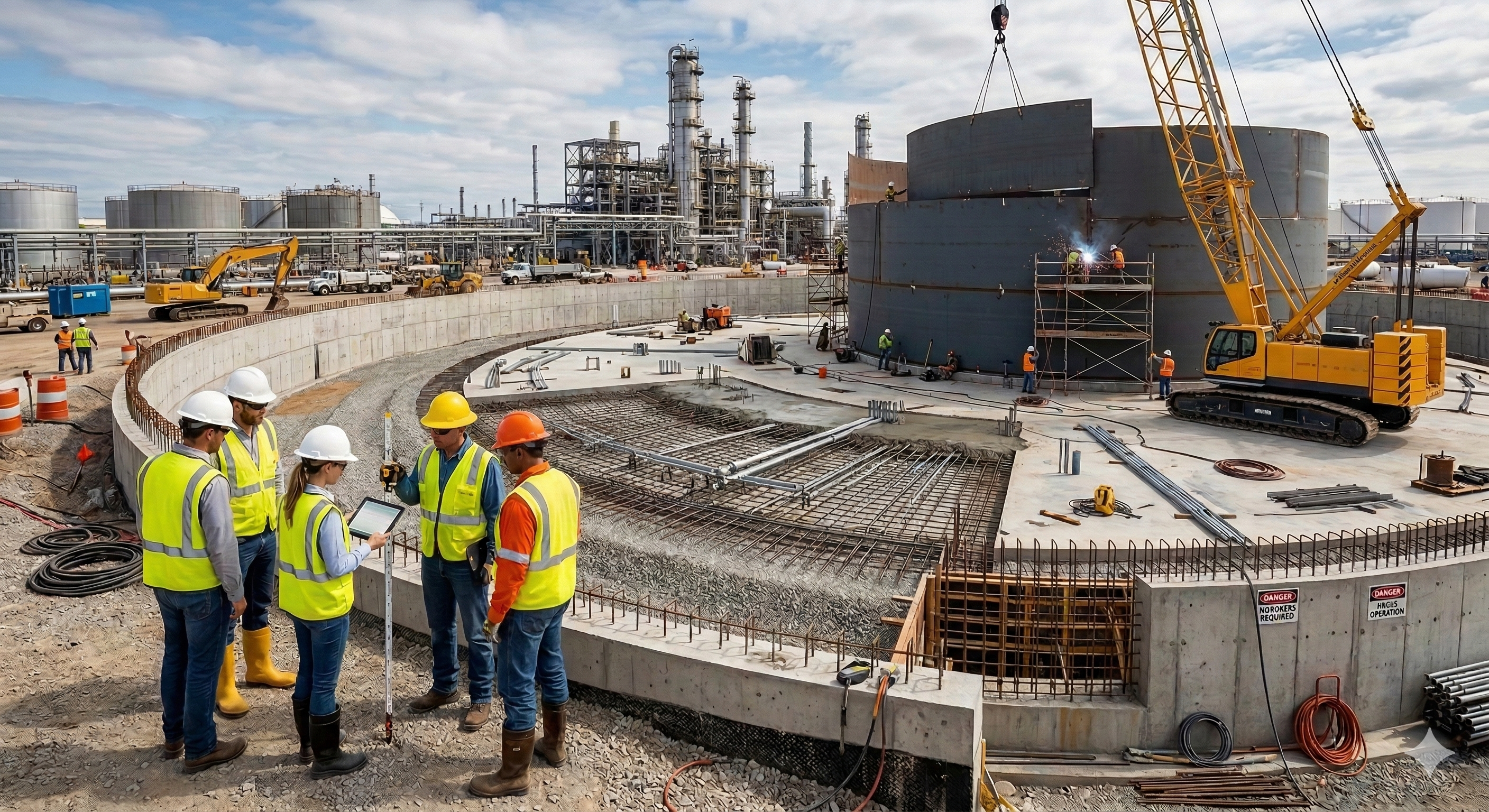
Instead of supporting the entire tank bottom, a reinforced concrete ring wall carries the heavy load of the tank shell and the roof. It acts like a continuous footing placed precisely under the tank’s perimeter. The interior of the ring is then backfilled with a granular material, often compacted sand or gravel, that supports the tank bottom.
This design allows the weight of the stored product to be distributed evenly across the full area of the tank bottom, which significantly reduces the risk of edge settlement where the shell meets the floor.
However, a ring wall isn't a set-it-and-forget-it component. Over the life of the facility, these structures require maintenance, which can include crack repair and, in some cases, releveling if the underlying soil wasn't as predictable as initially thought.
Full Slab Foundation
A full reinforced concrete slab foundation provides a uniform, level surface across the entire footprint of the tank. This is often the preferred route for smaller tanks, typically those less than 20 feet in diameter, or for bolted water storage tanks where a sealed concrete slab can actually serve as the tank bottom itself.
While a slab offers a solid platform, it’s important to understand its limitations regarding settlement. Like a compacted soil foundation, a standard flat slab may not inherently protect against edge settlement under the heavy tank shell. The structural behavior here is different from a ring wall. If the subgrade is stable and provides uniform support, a slab performs admirably. But if the soil is suspect, the slab is only as good as what’s underneath it.
Cracking is also a consideration. While minor shrinkage cracks are generally not a structural concern for the tank itself, uneven cracking caused by poor groundwater drainage or inadequate soil support can lead to problems down the road. In cases where slab stiffness is absolutely required to bridge weaker soil zones, a thicker, more heavily reinforced section is necessary.
Deep Foundations
When you’re dealing with poor soil conditions, think marine sediment deposits, soft peaty soils, or underconsolidated clays, a shallow foundation is off the table. This is where deep foundations, or piles, come into play. Pile foundations are used to transfer the tank loads through the weak upper strata down to a competent bearing layer.
There are two primary drivers for going with piles. First is settlement mitigation. In sites with compressible soils, piles can drastically reduce both total and differential settlement. Second is performance under load. For large storage tanks in specific locations like bulk fuel terminals, piles can also be engineered to handle significant uplift forces from seismic events or high water tables.
The design of a pile-supported ring wall foundation is complex. In these systems, the ring wall supports the shell, while the piles/piers transfer the foundation loads through weak strata to a competent bearing layer. It’s an expensive solution, but on a poor site, it’s often the only way to guarantee long-term stability. For very soft soils, pile or pile-raft systems are often the most reliable way to control settlement.
Engineering Criteria for Selection
Selecting the correct tank foundation types isn't a guessing game; it’s a process of matching the foundation's mechanical properties to the site’s physical realities. The decision matrix revolves around three critical factors.
Soil Bearing Capacity & Settlement Risk
Everything starts with the ground. A thorough geotechnical investigation will define the soil's bearing capacity and its propensity to settle. The goal is to prevent differential settlement, where one side of the tank settles more than the other, as this can distort the shell and stress the bottom plates. Acceptable settlement limits are established early, and the foundation is designed to ensure that the soil pressure beneath the ring wall or slab does not exceed the safe bearing capacity.
Tank Size and Load Characteristics
You can't design a foundation without knowing exactly what it will hold. Tank diameter and height dictate the hydrostatic load exerted on the base. Large diameter tanks create significant annular stress concentrations at the perimeter, which is why the tank ring wall foundation is so effective; it places high-strength concrete precisely where those stresses are highest. For smaller tanks, the load is less concentrated, making a slab a viable option.
Environmental & Site Factors
Finally, the environment writes the final requirements. In seismic zones, the foundation must be designed to handle the convective and impulsive forces of the sloshing liquid inside the tank, as outlined in standards like API 650. In colder climates, the depth of frost heave must be considered to prevent the ground from lifting and distorting the tank. And regardless of location, positive drainage away from the foundation perimeter is non-negotiable to prevent water from softening the subgrade and leading to settlement.
Settlement & Depression Issues
Tank Foundation Depression Solutions
When minor depressions or voids are detected, often under the tank bottom itself, the goal is to restore support. One effective tank foundation depression solution is filling the void. This involves drilling through the concrete ring or slab and injecting a slurry to fill the gaps between the steel bottom and the foundation.
In a documented case involving large oil tanks, a carefully formulated mix of cement, fly ash, and admixtures was used to fill these voids, effectively re-establishing contact and transferring the load back down to the ground. In other cases, improving drainage around the perimeter or reinforcing the edge with additional concrete can halt progressive settlement.
Tank Foundation Settlement Treatment
When settlement progresses beyond acceptable tolerances, targeted tank foundation settlement treatment may be required. Pressure grouting can improve bearing conditions beneath localized voids, while underpinning techniques may restore level support beneath critical areas.
In more severe cases, pile retrofit systems can be introduced to transfer loads to deeper strata. The appropriate method depends on soil profile, tank size, and operational constraints.
Tank Foundation Engineering Best Practices
Successful performance across all tank foundation types depends on disciplined execution of tank foundation engineering best practices:
- Proper Subgrade Preparation
Excavation, compaction, and grading must align with geotechnical recommendations. Gravel drainage layers should be installed and compacted to prevent moisture accumulation.
- Bearing Capacity Verification
Soil pressures beneath ringwalls or slabs must be checked against allowable values. Internal bearing beneath ringwalls requires equal scrutiny.
- Seismic & Wind Checks
Stability checks under wind and seismic loading, including impulsive and convective components, should be performed in accordance with API 650 Appendix E.
- Drainage Detailing
Water management is critical. Poor drainage remains one of the most common contributors to long-term settlement and erosion.
Conclusion: A Practical Decision Framework
Choosing between these tank foundation types shouldn't be a guessing game. By evaluating your soil reports, defining your specific load demands, and applying the right engineering standards, whether that’s API 650 or AWWA D-103, you can build a base that stands the test of time.
Recent Posts
Custom vs. Ready-Made Steel Tanks: What’s Best for You?
TES Tanks: What They Do, Why They Pay Off, How They Work
Caustic Soda Storage Tanks: No More Winter Flow Surprises
Bolted Tanks vs Welded Tanks: Selecting the Right Storage Tank(s) for Your Next Project